
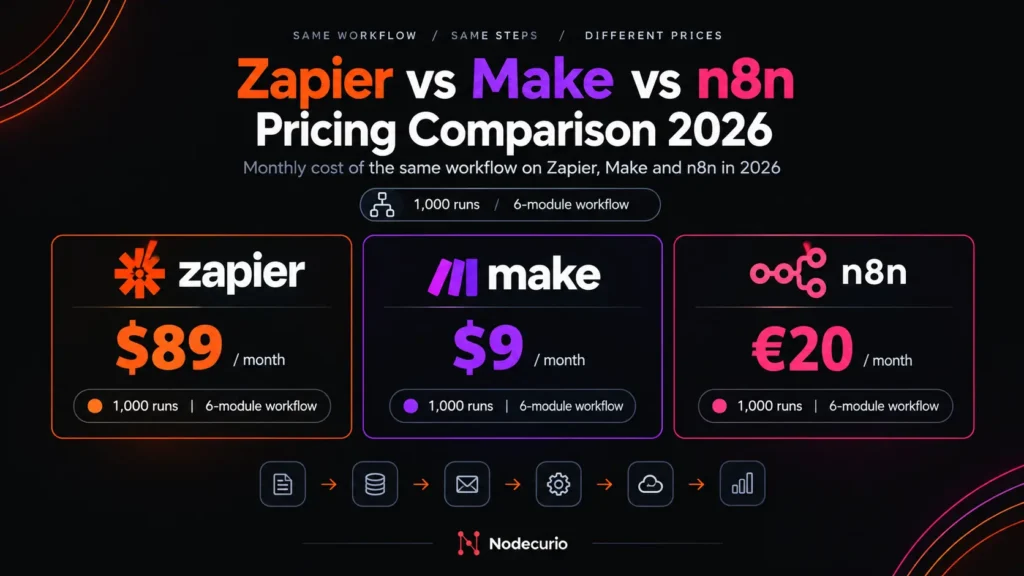
Short answer: Zapier, Make and n8n don’t sell the same unit. Zapier bills per action step, Make bills per module call, and n8n bills per whole workflow run. For a typical six-module workflow (one trigger plus five actions) running 1,000 times a month, the bill on annual pricing is about $89 on Zapier, $9 on Make and €20 on n8n Cloud – or roughly $6 for a self-hosted n8n server. At 10,000 runs a month the same workflow costs about $289, $54 and €50.
Every pricing guide lists the plan tiers. Very few do the calculation that actually decides your bill: what one run of your workflow costs on each platform, and how that changes as you add steps and volume. That is what this guide does – unit rates, the formula, real monthly bills at two volumes, the break-even point between Make and n8n, and the six ways a bill quietly outgrows its sticker price.
If you haven’t picked a platform yet, start with our full Zapier vs Make vs n8n comparison. This article is the money half of that decision.
Pricing verified: September 2026. Annual billing unless stated. Euro prices converted at €1 ≈ $1.15. See the methodology note at the end.
The one thing that decides your automation bill
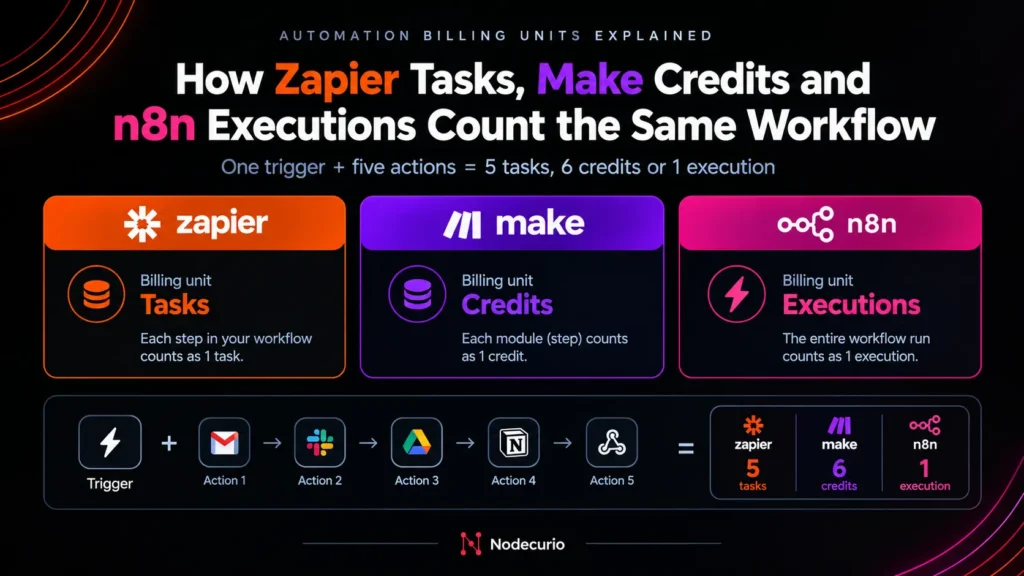
Three platforms, three completely different meters:
- A Zapier task is one successfully completed action step. The trigger is free, and so are built-in tools like Filters, Paths, Formatter, Delay and Looping. A Zap with one trigger and five actions uses 5 tasks per run.
- A Make credit is one module call – and the trigger module counts. Make renamed its billing unit from “operations” to “credits” on 27 August 2025, which is why many guides still say “operations”. The same trigger-plus-five-actions scenario uses 6 credits per run.
- An n8n execution is one complete workflow run, from trigger to finish, no matter how many nodes it passes through. Six nodes or sixty – it’s 1 execution.
That single design difference drives almost everything that follows. Zapier and Make charge you for complexity (steps per run). n8n charges you for frequency (runs). Which one is cheaper depends on which of those your workflows have more of – and on how much volume you buy, because each platform’s entry plan has a very different floor price.
Zapier vs Make vs n8n Pricing in 2026
Zapier pricing
Zapier’s plan name matters less than its task slider. Professional runs from 750 tasks up to 2 million, and the price climbs at every step while the cost per task falls.
| Plan and task tier | Price (annual) | Price (monthly) | Notes |
| Free – 100 tasks | $0 | $0 | Two-step Zaps only, 15-min polling |
| Professional – 750 tasks | $19.99/mo | $29.99/mo | Multi-step Zaps, webhooks, Paths, premium apps, 1 user, 2-min polling |
| Professional – 1,500 tasks | $39/mo | – | |
| Professional – 2,000 tasks | $49/mo | $73.50/mo | |
| Professional – 5,000 tasks | $89/mo | – | |
| Professional – 10,000 tasks | $129/mo | – | |
| Professional – 20,000 tasks | $189/mo | – | |
| Professional – 50,000 tasks | $289/mo | – | |
| Professional – 100,000 tasks | $489/mo | – | |
| Team – 2,000 tasks | from $69/mo | $103.50/mo | Up to 25 users, shared connections, SAML SSO, 1-min polling |
| Enterprise | Custom quote | ||
If you remember a cheaper entry tier, you’re thinking of the Starter plan, which Zapier retired on 2 April 2024. Professional is now the lowest paid tier. Zapier also advertises 9,000+ app integrations – the largest catalogue of the three.
Make pricing
| Plan | Price (annual) | Price (monthly) | Included |
| Free | $0 | $0 | 1,000 credits, 2 active scenarios, 15-min minimum interval |
| Core | $9/mo | $10.59/mo | 10,000 credits, unlimited scenarios, 1-min scheduling |
| Pro | $16/mo | $18.82/mo | 10,000 credits + priority execution, custom variables, full-text log search |
| Teams | $29/mo | $34.12/mo | 10,000 credits + team roles, shared scenario templates |
| Enterprise | Custom quote | ||
Core, Pro and Teams all ship the same 10,000 credits at their base step. Moving up a plan buys execution priority, log search and collaboration – not capacity. When you simply need more volume, scale the credit slider, not the plan. At 20,000 credits, Core is $18.82 a month on monthly billing.
A caution on Make’s numbers: some 2026 guides list Core, Pro and Teams at $12, $21 and $38 on annual billing. The figures above are what Make’s pricing page showed in September 2026, but Make displays different prices by currency and region. Check the live page with your own currency selected before you budget.
n8n pricing
| Plan | Price | Included executions | Notes |
| Community Edition (self-hosted) | €0 + your server | Unlimited | Free and open source; you run and maintain it |
| Starter (Cloud) | €20/mo annual (€24 monthly) | 2,500 / month | Unlimited workflows |
| Pro (Cloud) | €50/mo annual (€60 monthly) | 10,000 / month | Unlimited workflows |
| Business | ~€667/mo annual (€800 monthly) | 40,000 / month | Self-hosted option, SSO/SAML, Git version control |
| Enterprise | Custom quote | ||
n8n prices in euros, so non-euro buyers pay the day’s conversion. Companies with fewer than 20 employees can apply for n8n’s start-up programme, which discounts the Business plan. Because every Cloud tier includes unlimited workflows, execution volume is the only thing you are really buying.
The formula: what one workflow run actually costs
Strip the plan names away and every platform reduces to the same equation:
Monthly units = runs per month × units per run
Units per run = action steps (Zapier), modules including the trigger (Make), or exactly 1 (n8n). Then pick the smallest plan tier that covers that many units.
Divide each plan’s price by its included units and you get the rate that matters once you’re buying real volume:
| Plan | Price/mo | Included units | Cost per unit |
| Zapier Professional (750) | $19.99 | 750 tasks | $0.0267 per action step |
| Zapier Professional (2,000) | $49 | 2,000 tasks | $0.0245 per action step |
| Zapier Professional (5,000) | $89 | 5,000 tasks | $0.0178 per action step |
| Zapier Professional (50,000) | $289 | 50,000 tasks | $0.0058 per action step |
| Zapier Team (2,000) | $69 | 2,000 tasks | $0.0345 per action step |
| Make Core | $9 | 10,000 credits | $0.0009 per module |
| Make Pro | $16 | 10,000 credits | $0.0016 per module |
| n8n Starter | €20 (≈$23) | 2,500 executions | €0.008 (≈$0.0092) per run |
| n8n Pro | €50 (≈$58) | 10,000 executions | €0.005 (≈$0.0058) per run |
| n8n self-hosted (small VPS) | ~$6 | Unlimited | ~$0.0006 per run at 10,000 runs |
Depending on the tier, a Zapier task costs between 6 and nearly 40 times a Make credit. That is the number no pricing page shows you.
What 1,000 runs a month actually costs
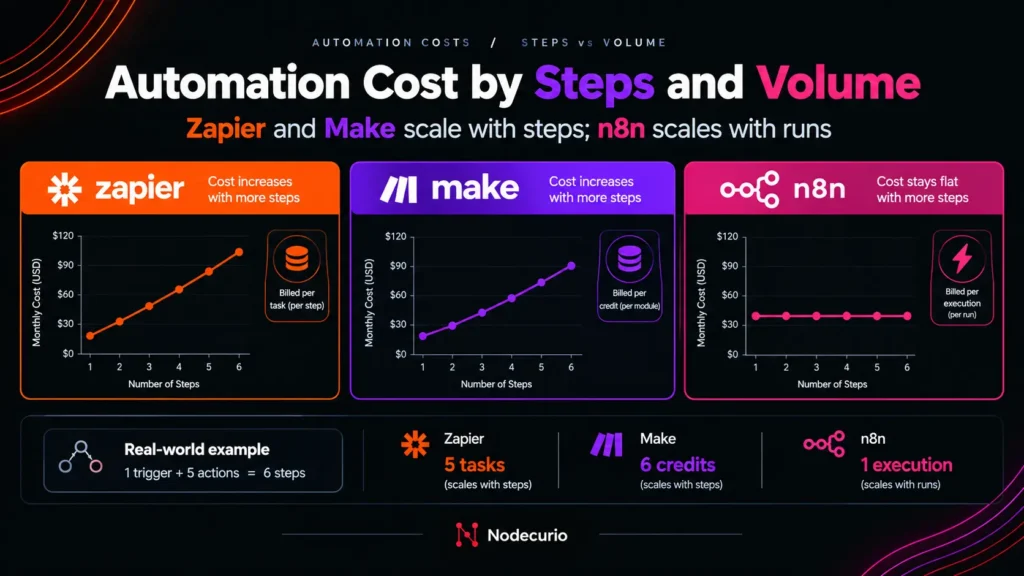
Here is one workflow priced as it grows in steps, at 1,000 runs a month. Each figure is the monthly bill for the smallest plan that covers the volume – not a pro-rated unit cost.
| Action steps per run | Zapier (tasks → tier) | Make (credits → plan) | n8n Cloud | n8n self-hosted |
| 2 | 2,000 → $49 | 3,000 → $9 | €20 (≈$23) | ~$6 |
| 3 | 3,000 → $80–89* | 4,000 → $9 | €20 (≈$23) | ~$6 |
| 5 | 5,000 → $89 | 6,000 → $9 | €20 (≈$23) | ~$6 |
| 8 | 8,000 → $129 | 9,000 → $9 | €20 (≈$23) | ~$6 |
| 12 | 12,000 → $189 | 13,000 → ~$16 | €20 (≈$23) | ~$6 |
| 15 | 15,000 → $189 | 16,000 → ~$16 | €20 (≈$23) | ~$6 |
Either the 5,000-task tier ($89) or the 2,000-task tier plus pay-per-task overage (about $80). Make’s 20,000-credit Core step is estimated at ~$16 annual from its $18.82 monthly price.
At this volume the answer is simple: Make Core wins on hosted price at almost any step count, because its $9 plan includes 10,000 credits and a 1,000-run workload rarely uses them up. n8n Cloud’s €20 floor is higher than Make’s for workloads this small, even though n8n doesn’t charge per step.
What 10,000 runs a month actually costs
Volume changes the picture. At 10,000 runs a month, you’re paying for capacity rather than a plan floor, and n8n’s per-run billing starts to matter:
| Action steps per run | Zapier (tasks → tier) | Make (credits, est.)** | n8n Cloud Pro | n8n self-hosted |
| 2 | 20,000 → $189 | 30,000 → ~$27 | €50 (≈$58) | ~$6 |
| 3 | 30,000 → $289 | 40,000 → ~$36 | €50 (≈$58) | ~$6 |
| 5 | 50,000 → $289 | 60,000 → ~$54 | €50 (≈$58) | ~$6 |
| 8 | 80,000 → $489 | 90,000 → ~$81 | €50 (≈$58) | ~$6 |
| 12 | 120,000 → $769 | 130,000 → ~$117 | €50 (≈$58) | ~$6–10 |
Make figures use Core’s base rate of $0.0009 per credit. Make’s slider rounds up to its next credit step and gets slightly cheaper per credit at high volume, so treat these as close estimates and confirm on the live slider.
Three findings fall straight out of these two tables:
- Zapier is never the cheapest option on price. It costs roughly 5 to 15 times Make for the same workflow, at both volumes.
- At low volume, plan floors decide. Below a few thousand runs a month, Make Core’s $9 plan beats n8n Cloud regardless of step count.
- At volume, n8n Cloud overtakes Make at about 6.4 modules per run. That is roughly five to six action steps plus a trigger. Below it, Make is cheaper; above it, paying per run beats paying per module, and the gap widens with every step you add.
The break-even: n8n Pro costs about $0.0058 per run (€50 ÷ 10,000 at €1 ≈ $1.15). Make Core costs $0.0009 per module. $0.0058 ÷ $0.0009 ≈ 6.4 modules per run. If your workflows average more modules than that and you run them at volume, n8n Cloud is cheaper; if fewer, Make is. A weaker euro pushes the break-even lower; a stronger one pushes it higher.
Three real budgets
Solo freelancer – one workflow, 4 actions, 250 runs a month. That’s 1,000 Zapier tasks, 1,250 Make credits or 250 n8n executions. Zapier needs its 1,500-task tier at $39/mo. Make Core covers it at $9/mo with 87% of the credits unused. n8n Cloud Starter is €20 – a higher floor for capacity you won’t touch.
Winner: Make Core, about $360 a year cheaper than Zapier.
Small agency – 6 workflows with 6 actions each, 2,000 runs a month in total. That’s 12,000 Zapier tasks (the 20,000-task tier at $189/mo, or the 10,000 tier plus overage at around $160), 14,000 Make credits (Core’s 20,000-credit step at ~$16/mo), or 2,000 n8n executions (€20/mo on Starter, or ~$6 self-hosted).
Winner: Make on hosted price, or self-hosted n8n if someone on the team is comfortable running a server. Either saves roughly $1,700–2,100 a year against Zapier.
Ops team at volume – 50,000 runs a month, 8 actions each. Zapier is 400,000 tasks – about $1,269/mo on the 400,000-task Professional tier, a five-figure annual line item. Make is 450,000 credits, roughly $340–400/mo depending on the slider step. n8n is 50,000 executions – above the Business plan’s 40,000, so an Enterprise quote on Cloud, or self-hosted in queue mode on a $20–40/month server. At this scale the conversation stops being about features and becomes infrastructure versus invoice.
What Zapier’s premium actually buys
Unit cost is one variable, and for plenty of teams it isn’t the one that matters most.
Zapier’s 9,000+ integrations go meaningfully deeper into the long tail than Make’s 3,000+ or n8n’s roughly 1,000 native nodes. If your stack includes a niche CRM, a regional payment gateway or an industry-specific tool, Zapier is often the only platform with a maintained connector – and a $200-a-month bill still beats a developer spending a week building and maintaining a custom API integration.
Zapier also asks the least of the person building the workflow. Make’s canvas rewards people who enjoy it. n8n assumes you’re comfortable with JSON, expressions and, if you self-host, a server. If your automation owner is a marketer with no engineering support, the cheapest platform on paper can be the most expensive one in practice.
The useful question isn’t “which is cheapest?” but “at what monthly spend does the price gap exceed the cost of migrating?” As a rule of thumb, once Zapier spend passes $150–250 a month, it is worth pricing the same workflows on Make or n8n.
Six ways your bill outgrows the sticker price
1. Scheduled triggers bill even when nothing happens
In n8n, a schedule trigger creates an execution every interval whether or not there’s work to do. A workflow set to run every 5 minutes produces 8,640 executions a month on its own – enough to exhaust Starter’s 2,500 in about nine days. Webhooks fire only on real events and are the single biggest execution saving available.
2. Make charges for the trigger; Zapier doesn’t
A three-module scenario in Make costs 3 credits per run. The equivalent Zap costs 2 tasks. When you compare or migrate workflows, adjust for that off-by-one – at 20,000 runs a month it’s 20,000 extra credits.
3. Iterators, routers and loops multiply everything
This is where estimates go wrong by an order of magnitude. Make bills one credit per module per item. A scenario that rescans a 400-row sheet through four action modules costs 1,601 credits per run. Switching to a “watch new rows” trigger that picks up only the 20 new rows drops the same work to 81 credits – about 95% cheaper. In Zapier, the Looping tool itself is free, but every action inside the loop uses one task per iteration.
4. Overages and running out of credits
Zapier doesn’t stop your Zaps when you hit your task limit. It bills extra tasks at 1.25 times your plan’s per-task rate, up to three times your included volume. Make works the other way: when credits run out, scenarios stop until you add more, and extra credits cost 25% more than credits included in your plan. n8n Cloud caps you at your plan’s executions. Size your plan for your busiest month, not your average one.
5. AI steps and code don’t bill like normal steps
Make’s AI features and code execution can consume credits at different rates from standard modules, and Zapier’s AI products (Agents, Chatbots, MCP) have their own meters – Zapier MCP calls, for example, use 2 tasks each. On every platform, if your workflow calls OpenAI, Anthropic or another model through your own API key, those tokens are a separate bill. For AI-heavy workflows, model spend can easily exceed automation spend.
6. Seats and collaboration
Zapier Professional includes one user; shared connections and SSO start at Team ($69/mo). Make gates team roles and shared templates behind Teams ($29/mo). n8n Cloud doesn’t charge per workflow, which makes it simpler to scale across a small team – check the current seat terms on n8n’s pricing page for your tier.
No-code app builders price seats very differently too – our comparison of Bubble, Glide, Softr and Airtable shows what that means at 10 and 200 users.
Self-hosted n8n: the real cost
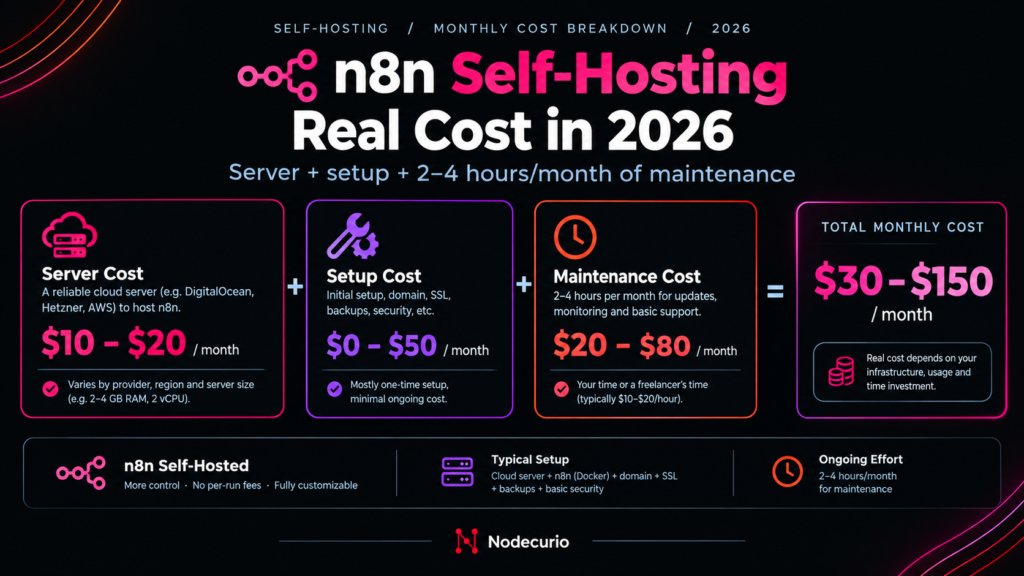
“Free” software still needs a server and someone to look after it. A realistic 2026 self-host looks like this:
- Server: $4–7 a month for a small VPS running n8n in Docker. Heavier workloads using queue mode and Postgres push that to $20–40.
- Setup: 30–60 minutes following a current guide – longer if you set up SSL, a custom domain and automated backups properly, which you should.
- Maintenance: updates, backups, security patches and uptime. Budget 2–4 hours a month unless you use a managed one-click host, and accept that when it breaks at 2am, you’re the on-call engineer.
The cash saving is real: roughly $200–620 a year versus n8n Cloud (Starter or Pro), and far more against Zapier. The trade is that you’ve swapped a subscription for an operational responsibility. Self-host if your workflows are high-volume and you genuinely don’t mind server maintenance. Stay on Cloud if an outage would cost you more than the subscription does.
How to cut an automation bill by 40–70%
- Filter before you act. Zapier Filters and Paths are free – put them immediately after the trigger so paid actions only run on records that qualify.
- Replace polling with webhooks wherever the source app supports them. Fewer wasted runs on n8n, fresher data everywhere.
- Batch instead of looping. Aggregate records and write once, instead of one write per record.
- Collapse formatting chains. Six formatting modules in Make cost six credits per run. Doing the same transformation in fewer modules – or in the source app before the data arrives – cuts that directly. (Make’s code execution bills differently from standard modules, so check the credit cost before replacing modules with code.)
- Consolidate near-duplicate workflows. Five similar Zaps can often become one workflow with a router or Paths step. On n8n this is especially effective because you’re billed per run.
- Run a hybrid stack. Keep niche app connections on Zapier’s cheapest viable tier and move your two or three highest-volume workflows to Make or n8n. You keep the integration coverage and remove most of the task consumption.
- Switch to annual billing once volume is stable – about 17% off on n8n, 15% or more on Make and up to 33% on Zapier. Do it after two months of real usage data, not before.
Which one should you actually pay for?
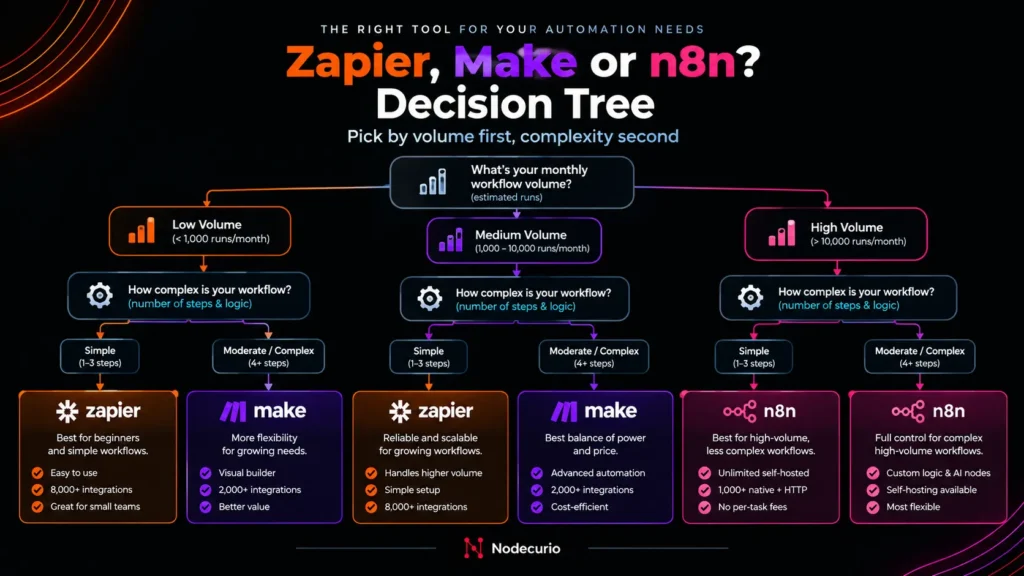
- Low volume (under a few thousand runs a month), any complexity → Make Core. Lowest hosted floor price, 10,000 credits included, visual builder.
- High volume with workflows of six or more modules → n8n. Cloud if you want zero infrastructure work; self-hosted if you’re comfortable with Docker.
- Your apps only exist on Zapier, or the builder is non-technical and unsupported → Zapier. Pay the premium knowingly, and re-price your workflows once spend passes $150 a month.
- Mixed reality (most teams) → hybrid. Zapier for coverage, Make or n8n for volume.
For the feature-by-feature side of this decision – builder experience, error handling, AI capabilities and app coverage – see our complete Zapier vs Make vs n8n comparison.
Frequently asked questions
What is the difference between a Zapier task, a Make credit and an n8n execution?
A Zapier task is one successfully completed action step; triggers and built-in tools like Filters are free. A Make credit is one module call, including the trigger. An n8n execution is one complete workflow run, regardless of how many nodes it contains. A workflow with one trigger and five actions therefore uses 5 tasks, 6 credits or 1 execution per run.
Which is cheapest – Zapier, Make or n8n?
Self-hosted n8n is cheapest on cash cost at almost any volume, at roughly $4–7 a month for a small server, but you maintain it yourself. Among hosted plans, Make Core at $9 a month is cheapest for most small workloads. n8n Cloud becomes cheaper than Make only at higher volume and when workflows average more than about six modules per run. Zapier was the most expensive in every scenario we calculated.
Why does Make say credits instead of operations?
Make switched its billing unit from operations to credits on 27 August 2025. For standard modules the accounting is unchanged – one module call uses one credit – but AI features and code execution can consume credits at different rates. Older guides that say “operations” are still broadly accurate for standard modules.
Does Zapier still have a Starter plan?
No. Zapier retired the Starter plan on 2 April 2024, which made Professional the lowest-priced paid tier, starting at $19.99 a month billed annually for 750 tasks.
Do triggers count as tasks in Zapier?
No. Zapier triggers are free, as are built-in tools such as Filters, Paths, Formatter, Delay and Looping. Only successfully completed action steps use tasks. Make, by contrast, charges one credit for the trigger module.
Does n8n charge more for a 20-step workflow than a 3-step one?
No. n8n bills one execution per workflow run regardless of how many nodes it contains, which is why its cost advantage grows as workflows become more complex and run more often.
How much does self-hosted n8n really cost?
Typically $4–7 a month for a small VPS, rising to $20–40 for high-volume setups using queue mode and Postgres. Add 30–60 minutes of setup and around 2–4 hours a month of maintenance. The cash saving versus n8n Cloud is roughly $200–620 a year.
What happens if I exceed my Zapier task limit?
Zapier keeps running your Zaps and bills the extra tasks at 1.25 times your plan’s per-task rate, up to three times your plan’s included tasks. If you regularly go over, moving to the next task tier is usually cheaper than paying overage.
What happens if I run out of Make credits?
Your scenarios stop until you add credits. Make sends warnings at 75% and 90% of your allowance, and extra credits cost 25% more than the credits included in your plan, so it pays to size your plan for your busiest month.
Is Make’s Pro plan worth it over Core?
Only for visibility and speed, not capacity – both include 10,000 credits at the base step. Pro adds priority execution, custom variables and full-text log search. If your scenarios run on a schedule and you rarely debug, stay on Core and spend the difference on more credits.
How do I estimate how many tasks or credits I need?
Multiply your expected monthly runs by units per run: action steps for Zapier, modules including the trigger for Make, and 1 for n8n. Then add 30–50% headroom for retries, loops and growth. Most people underestimate usage because they count workflows instead of steps.
Can I use more than one automation platform?
Yes, and for cost reasons many teams should. A common pattern is keeping Zapier on its lowest viable tier for niche app connectors, while moving the two or three highest-volume workflows to Make or n8n. This keeps integration coverage while removing most of the task consumption that drives the bill.
Methodology and verification
Plan prices in this article were checked against the vendors’ published pricing pages and help documentation in September 2026, with annual and monthly billing compared. Monthly bills and per-unit rates are calculations derived from those published prices under the stated assumptions – they are not invoices from a production account, and they exclude taxes, AI credit consumption, LLM token costs and the cost of the connected apps themselves. Euro prices were converted at €1 ≈ $1.15, the approximate mid-market rate in September 2026. Where a Make price falls between published slider steps, we have estimated it and said so.
Where sources disagree – notably Make’s Core, Pro and Teams prices, which some 2026 guides list at higher figures – we note the discrepancy rather than silently picking one. All three vendors adjust their pricing sliders and regional rates from time to time, so confirm the live figures before you commit to an annual plan. Our fact-checking policy explains how we verify and date claims, and our editorial policy covers our independence.
Primary sources: Zapier pricing · Make pricing · n8n pricing · Make credit and pricing changes.
Last verified: September 2026. Spotted a price that’s changed? Tell us and we’ll update it.
4 thoughts on “Zapier vs Make vs n8n Pricing in 2026: What Your Workflows Really Cost”